



Is Your Finance and Accounting Team Operating Effectively The Finance and accounting department of...
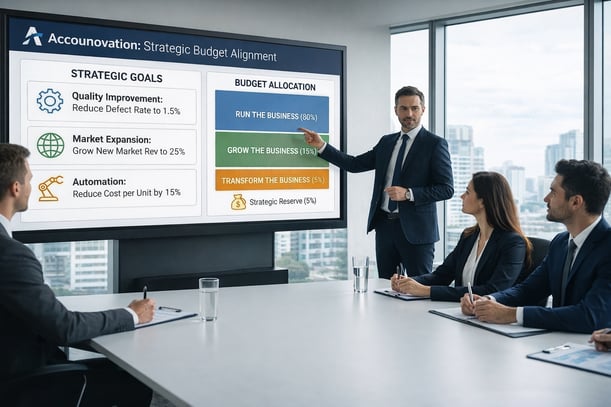
Your strategic plan says quality and innovation are priorities. But when you examine your budget, 90% goes to maintaining current operations while improvement initiatives fight for scraps. Sales wants to penetrate new markets, but marketing budget stays flat. Operations needs automation to improve efficiency, but capital budget focuses on replacing old equipment rather than strategic upgrades.
This disconnect between strategy and budgets is endemic in manufacturing. Companies spend weeks developing strategic plans, then create budgets using last year's numbers plus inflation. Strategy becomes aspiration while budgets reflect inertia.
The result? Strategic priorities remain unfunded. Resources flow to whoever asks loudest rather than what matters most. Opportunities pass while you're locked into incremental thinking. Years later, you're still talking about the same strategic priorities—never actually achieving them.
Aligning budgets with strategic goals transforms budgeting from bureaucratic exercise to strategic tool. When financial resources flow to strategic priorities, strategy becomes reality instead of slides in a deck.
Here's how to align your manufacturing budget with strategic goals.
Why Budgets and Strategy Disconnect
Before fixing the alignment problem, understand why budgets and strategy diverge:
Timing mismatch: Strategic planning happens annually (or less). Budgeting happens annually but uses historical data. Strategy looks forward; budgets look backward.
Different owners: Strategy often owned by leadership or planning teams. Budgets owned by finance and department managers. Limited coordination between them.
Incremental thinking: Budgets start with last year's actuals, add adjustments, call it done. This perpetuates historical allocations regardless of strategic relevance.
Political allocation: Without strategic framework, budgets become political negotiation. The squeakiest wheel gets resources, not the highest strategic priority.
Activity focus vs. outcome focus: Budgets track activities and spending. Strategy focuses on outcomes and goals. Hard to connect activities to outcomes without intentional alignment.
Short-term pressure: Budgets face immediate constraints (cash, profit targets). Long-term strategic investments get deferred when short-term pressure mounts.
Understanding the importance of budgeting for maximizing profitability provides context for why strategic alignment matters.
Step 1: Clarify Strategic Goals First
Budget alignment starts with crystal-clear strategic goals. Vague strategy produces vague budget alignment.
Poor strategic goals:
- "Improve quality"
- "Grow the business"
- "Increase efficiency"
- "Better customer service"
Strong strategic goals:
- "Reduce defect rate from 3.2% to 1.5% by Q4 2027"
- "Grow revenue from new markets to 25% of total by 2028"
- "Reduce cost per unit by 15% through automation by year-end 2027"
- "Achieve 90% on-time delivery (currently 78%) by Q2 2027"
Strong goals are specific, measurable, time-bound, and meaningful to business success. They translate directly into budget requirements.
For each strategic goal, identify:
- What activities or investments will achieve it?
- What resources (people, capital, operating budget) are required?
- What timeline drives spending?
- How will success be measured?
Without clear goals and resource requirements, budget alignment becomes guesswork.
Step 2: Categorize All Spending
Classify every budget item into one of three categories:
Run the Business (RTB)
Spending required to maintain current operations at current levels. These are table stakes—the business stops without them.
Examples:
- Production labor at current volumes
- Materials for current product mix
- Facility rent and basic utilities
- Existing customer support
- Required maintenance
- Compliance and regulatory costs
RTB typically represents 80-85% of budget for established manufacturers. This doesn't mean it's unimportant—just that it's maintaining, not advancing strategy.
Grow the Business (GTB)
Spending that increases revenue, expands capacity, or enters new markets. These investments drive growth.
Examples:
- Sales and marketing for new markets
- Capacity expansion
- New product development
- Distribution channel expansion
- Strategic acquisitions
- Customer acquisition investments
GTB typically represents 10-15% of budget. Higher for high-growth companies, lower for mature businesses.
Transform the Business (TTB)
Spending that fundamentally changes how you operate or compete. These are strategic game-changers.
Examples:
- Major automation or technology implementations
- New business model initiatives
- Operational excellence programs
- M&A integration
- Product line restructuring
- Digital transformation
TTB typically represents 5-10% of budget. These are typically discrete projects with defined timelines and outcomes.
Understanding dynamic budgeting approaches helps maintain flexibility as strategic needs evolve.
Step 3: Map Budget to Strategic Priorities
With spending categorized and strategic goals clear, map budget explicitly to strategy:
Create a strategic goal budget template:
|
Strategic Goal |
Owner |
Total Budget |
Q1 |
Q2 |
Q3 |
Q4 |
Success Metric |
|
Reduce defect rate to 1.5% |
Ops Director |
$450K |
$100K |
$150K |
$120K |
$80K |
Defect rate |
|
New markets to 25% revenue |
Sales VP |
$380K |
$80K |
$100K |
$100K |
$100K |
New market % |
|
Automate Line 3 |
Ops Director |
$1.2M |
$200K |
$400K |
$400K |
$200K |
Cost per unit |
This makes strategic investments explicit and trackable. Everyone sees what's funded, who's accountable, and how success is measured.
For each strategic goal:
- Allocate specific budget
- Assign ownership
- Define timeline
- Establish success metrics
- Identify quarterly milestones
This transforms strategy from vague aspiration to funded, managed initiatives.
Step 4: Apply Zero-Based Thinking to Strategic Initiatives
Traditional budgeting starts with last year and adjusts. Zero-based thinking asks: "If we were starting fresh, what would we fund?"
For strategic initiatives, use zero-based approach:
For each potential strategic investment:
Define the opportunity: What specific outcome will this achieve? How does it advance strategic goals?
Quantify the return: What's the financial impact? Cost reduction, revenue growth, risk mitigation? Over what timeframe?
Determine resource requirement: What will it actually cost—capital, operating expense, people time, management attention?
Identify alternatives: Are there other ways to achieve the same outcome? What's the best approach?
Prioritize vs. other opportunities: How does this compare to other potential investments? What's the ROI and strategic importance?
This rigorous evaluation prevents strategic budget allocation from becoming "wish list" funding and ensures limited resources flow to highest-impact opportunities.
Understanding how to conduct pricing and margin analysis helps evaluate financial returns on strategic investments.
Step 5: Challenge "Run the Business" Spending
RTB spending gets least scrutiny because it's "necessary." But 80-85% of budget locked into "necessary" leaves little room for strategic investments.
Challenge RTB assumptions:
Is all of it truly necessary? Or have certain activities become habit rather than value-creation?
Can efficiency improvements reduce RTB? Process improvements, automation, or outsourcing might maintain operations at lower cost, freeing budget for strategy.
Are we over-servicing some areas? Are resources allocated based on historical patterns rather than current strategic importance?
Can we standardize or consolidate? Multiple systems, processes, or suppliers often cost more than streamlined alternatives.
What would we stop doing? If forced to cut 10%, what would go? This reveals what's truly essential vs. nice-to-have.
Even 5% RTB reduction in a $10M budget frees $500K for strategic investments—often enough to fund multiple high-priority initiatives.
Understanding cost structure analysis for higher profit margins provides frameworks for optimizing RTB spending.
Step 6: Create Strategic Reserve
Rigid budgets that allocate every dollar leave no flexibility when strategic opportunities or challenges emerge mid-year.
Build strategic reserve: Hold back 3-5% of budget unallocated at year start. This reserve funds:
Unexpected strategic opportunities: Customer offers significant volume if you can deliver quickly. Competitor exits market creating acquisition opportunity. Technology breakthrough enables competitive advantage.
Strategic pivots: Market conditions shift requiring strategy adjustment. Strategic initiatives need more resources than anticipated. New competitive threats require defensive investments.
Learning investments: Strategic experiments that test hypotheses before major commitments.
Strategic reserve isn't "slush fund"—it's explicitly managed budget for strategic optionality. Requirements for accessing it:
- Clear strategic rationale
- Expected outcomes defined
- Leadership approval
- Tracking and accountability
This reserve prevents "we have no budget for that" from blocking strategic opportunities that emerge after annual budget is set.

Step 7: Implement Rolling Strategic Budget Reviews
Annual budgeting with fixed allocations creates rigidity. Strategy evolves continuously—budgets should too.
Quarterly strategic budget reviews:
Assess progress on strategic initiatives: Are funded initiatives on track? Achieving milestones? Delivering expected outcomes?
Evaluate strategic assumptions: Have market conditions, competitive dynamics, or customer needs changed? Do strategic priorities need adjustment?
Reallocate if needed: Pull funding from underperforming initiatives. Add resources to high-performers. Fund new priorities that have emerged.
Project forward: Update projections for remaining quarters. Identify emerging needs or opportunities.
This quarterly discipline keeps budgets aligned with evolving strategy rather than locked into January assumptions.
Understanding how to build a rolling forecast that actually works extends to rolling strategic budget management.
Step 8: Establish Clear Decision Rights
When strategy and budget compete, who decides? Without clear decision rights, strategic budget allocation becomes endless negotiation.
Define decision framework:
Strategic investment threshold: What spending level requires leadership approval vs. departmental authority?
Reallocation authority: Who can shift budget between initiatives? What's the process?
Strategic reserve access: Who approves draws from strategic reserve? What justification is required?
RTB optimization: Who can reduce RTB spending to fund strategic initiatives?
Trade-off resolution: When strategic priorities compete for limited resources, who makes final call?
Clear decision rights accelerate strategic budget allocation and prevent gridlock when tough choices arise.
Step 9: Connect Budget to Accountability
Strategic budget alignment only works if people are accountable for outcomes, not just spending.
For each strategic initiative:
Define success metrics: Not "spent $450K on quality program" but "reduced defect rate from 3.2% to 1.8%"
Establish milestones: Quarterly checkpoints showing progress toward goal
Assign clear ownership: One person accountable for results (not committees)
Link to performance: Strategic goal achievement factors into performance reviews and compensation
Report progress: Monthly or quarterly updates to leadership on all strategic initiatives
This accountability ensures strategic budget allocation translates to strategic goal achievement, not just strategic spending.
Understanding financial KPIs includes strategic goal metrics tracked alongside financial performance.
Common Alignment Mistakes
Strategy after budget: Budget first, then trying to fit strategy. Should be reversed—strategy drives budget.
Everything is strategic: Labeling all spending "strategic" to justify it. True strategic initiatives are distinct.
Unfunded mandates: Strategic goals without budget. Strategy without resources is wishful thinking.
Set and forget: Annual alignment then 12 months of ignoring. Requires quarterly review.
Activity vs. outcome: Tracking strategic spending rather than outcomes. Budget is means, not goal.
No trade-offs: Trying to fund everything equally. Strategic alignment requires prioritization.
Making It Practical
Start small and build capability progressively:
Year 1: Identify top 3 strategic priorities. Explicitly allocate budget. Track quarterly progress.
Year 2: Expand to 5-7 priorities. Implement RTB/GTB/TTB categorization. Start quarterly reviews.
Year 3: Full strategic alignment. Zero-based thinking on initiatives. Strategic reserve. Rolling reviews embedded.
Working with a fractional CFO helps establish frameworks without overwhelming your team.
The Bottom Line
Budgets aligned with strategic goals transform strategy from aspiration to reality. When financial resources flow to strategic priorities, those priorities actually get achieved. When budgets ignore strategy, you endlessly discuss the same goals without progress.
The process: Clarify strategic goals with specific outcomes. Categorize spending (RTB/GTB/TTB). Map budget explicitly to strategic priorities. Apply zero-based thinking to strategic initiatives. Challenge RTB spending to free strategic resources. Create strategic reserve for flexibility. Review quarterly and reallocate as needed.
This isn't more bureaucracy—it's making budgeting strategic. Instead of incremental adjustments to last year's spending, you're consciously allocating limited resources to highest-priority goals.
The manufacturers who win are those who execute strategy, not those with the best strategic plans. Aligned budgets are what enable execution. Strategic goals need resources. Aligned budgets provide them. Everything else is just talking about strategy.