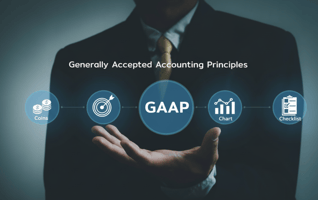



If you run a manufacturing business, you’ve probably heard the term GAAP thrown around during...

When SaaS founders begin preparing for fundraising—whether it’s seed, Series A, or preparing for future acquisition—one topic eventually comes up in discussions with investors: GAAP vs non-GAAP financial reporting. It’s one of the most misunderstood areas of financial communication, and yet it has a major impact on valuation, trust, negotiation power, and due diligence.
Think of GAAP as the standardized financial language that everyone agrees on. It’s what accountants, auditors, and many investors rely on. Non-GAAP, meanwhile, is a more flexible style of reporting—one designed to highlight the performance of the business in a way GAAP sometimes cannot. Many fast-growing SaaS companies use non-GAAP adjustments to tell a clearer story of operational performance, especially when the business is scaling rapidly.
Before presenting financials to investors, founders must understand how these two frameworks differ—and how to use them responsibly and strategically.
Just like manufacturing leaders need clarity on what GAAP is and why it matters, SaaS founders benefit from mastering the difference so they can communicate financial performance confidently and transparently.
What GAAP Represents and Why Investors Trust It
GAAP is the standard for accounting in the United States, and many investors rely on it because it creates consistency. Numbers are calculated using uniform rules. Revenue is recognized in the same way. Expenses follow specific guidelines.
This consistency allows investors to compare your company to others—apples to apples.
If an investor looks at your financials and someone else’s, GAAP gives them a fair basis for comparison. It also supports stronger due diligence, cleaner audit trails, and smoother scrutiny throughout fundraising.
This is similar to how manufacturers rely on consistent metrics when reviewing financial accounting vs managerial accounting or analyzing performance through disciplined business performance metrics.
| Metric | GAAP Reporting | Non-GAAP Reporting |
|---|---|---|
| Purpose | Standardized financial view | Operational performance view |
| Used By | Auditors, lenders, conservative investors | Growth investors, founders, strategic analysts |
| Treatment of Non-Recurring Costs | Included | Often excluded |
| Revenue Recognition | Strict and uniform | Adjusted to reflect recurring economics |
| Stock-Based Compensation | Counted as expense | Often excluded |
| Valuation Interpretation | Conservative snapshot | Growth-adjusted earnings story |
| Industry Comparability | High | Moderate |
| Flexibility | Low | High |
Why Companies Use Non-GAAP Reporting
While GAAP provides uniformity, it is not always the best reflection of your operational reality. Non-GAAP reporting allows companies to adjust certain items to tell a clearer performance story.
For fast-growing SaaS companies, common adjustments include removing non-recurring expenses, isolating growth-driven investments, or excluding stock-based compensation when measuring profitability. The goal is not to distort numbers—but to present a normalized view of how the business performs on a day-to-day operating basis.
This mirrors the logic behind adjustments used when calculating adjusted EBITDA, where unusual or one-time costs are removed to better demonstrate recurring earning power.
Non-GAAP numbers often reflect future-state profitability rather than historical accounting treatment.
Why GAAP Alone Can Undervalue High-Growth SaaS Businesses
Startups invest heavily in engineering, customer acquisition, onboarding, and expansion. Yet GAAP often treats these growth investments strictly as expenses, reducing net income and making performance appear weaker than it actually is.
A founder might look unprofitable on paper while actually building a highly scalable revenue engine.
For example:
-
GAAP expenses sales and marketing up front, even if those costs lead to recurring revenue for years.
-
GAAP depreciation and amortization may distort cash flow, especially when software assets are involved.
-
GAAP recognizes annual contracts differently depending on billing timing.
This is where non-GAAP helps investors see the underlying revenue strength rather than the momentary cost burden of growth.

Why Investors Want to See Both
Sophisticated investors expect both views.
GAAP provides financial discipline and compliance.
Non-GAAP provides operational insight and growth trajectory.
If a founder only presents GAAP statements, they may unintentionally undersell the strength of the business. If they present only non-GAAP, they risk being seen as opaque or selective.
Presenting both signals transparency, maturity, and financial sophistication—the same qualities that help manufacturers navigate growth using tools such as strategic financial planning or clean metrics dashboards.
Presenting GAAP and Non-GAAP the Right Way
Founders should keep one principle in mind: non-GAAP is an enhancement—not a replacement.
When presenting to investors, make the GAAP statements the foundation and then walk through the non-GAAP adjustments. Be consistent with your adjustments, document them, and avoid aggressive exclusions that could appear misleading.
Investors are not looking for an adjusted reality—they are looking for a clearer one.
| Adjustment | Why It’s Used | How It Helps Investors |
|---|---|---|
| Stock-Based Compensation | Non-cash and dilution-based | Clarifies true cash operational cost |
| One-Time Legal or Advisory Costs | Non-recurring | Shows normalized profitability |
| Exceptional Write-offs | Legacy or discontinued expenses | Removes financial noise |
| Restructuring Costs | Temporary business transitions | Displays future-state financial health |
| Acquisition-related Costs | One-time integration expense | Isolates recurring performance |
| Unrealized FX Gains/Losses | Currency swings | Removes volatility impacts |
| Non-operational Income/Expense | Not tied to core business | Focuses on core earning engine |
The Bottom Line
GAAP tells the standardized financial story. Non-GAAP tells the operational story.
Founders who master both can communicate value more clearly, negotiate from a position of trust, and demonstrate a deeper understanding of their business model. The combination of GAAP discipline and non-GAAP transparency gives investors confidence—not just in the financials, but in the leadership behind them.
If you're preparing for fundraising and want support presenting clean, investor-ready financials, Accounovation can help. Our team understands how to structure GAAP and non-GAAP reporting in a way that increases clarity, demonstrates operational strength, and builds investor confidence. Reach out to Accounovation if you want financial statements that tell the full story of your business.